Rolling green hills and golden farmland patterns in the Moravian countryside of Czechia

One Small Country.
Six Distinct Worlds.

Czechia is smaller than South Carolina — but every region has its own landscape, its own kitchen, its own rhythm. From sandstone towers to wine cellars, from Gothic spires to open plains, here is a country that keeps unfolding.

Every Region Is Its Own World

Most travelers arrive in Prague, spend two or three days exploring the Old Town, and then fly home. They leave believing they have seen Czechia. They have not. They have seen the gateway.

Czechia is one of the most geographically compact countries in Europe — roughly 280 miles from east to west, 130 from north to south. You can drive across the entire nation in under four hours. And yet, within that modest footprint, the landscape reinvents itself over and over again. Sandstone towers in the north give way to dense Bohemian forests in the west. Flat, sun-drenched vineyards in Moravia feel nothing like the dramatic gorges of Bohemian Switzerland. The ornate colonnades of Karlovy Vary belong to a different century — and a different sensibility — than the painted folk houses of Slovacko.

This is a country where a two-hour train ride doesn't just change the scenery. It changes the food on your plate, the accent you hear at the pub, the stories people tell about themselves. Each region has spent centuries developing its own identity, its own traditions, its own quiet pride. And the best way to experience Czechia is to let each one speak for itself.

Below, we have divided the country into six travel regions — not political boundaries, but the natural groupings that make sense when planning a trip. Start with one, or connect them in a loop. Either way, the country will surprise you.

What Makes Each Region Special

A brief portrait of each region — what defines it, what you will find there, and why it matters for your trip.

Prague — The Gateway City

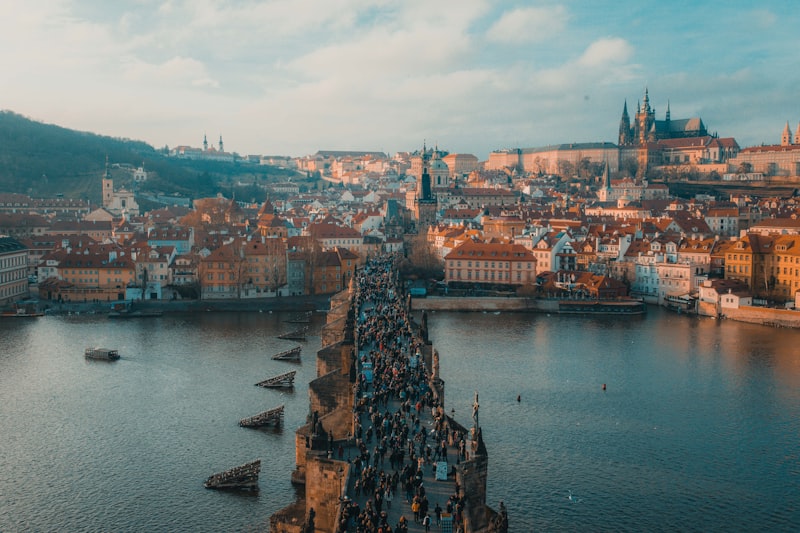
Everyone starts here, and for good reason. Prague is one of Europe's most visually stunning capitals: a skyline of Gothic spires, baroque domes, and Art Nouveau facades reflected in the Vltava River. The Old Town Astronomical Clock, Charles Bridge at dawn, the vast Prague Castle complex — these are icons. But Prague's real magic lives in its neighborhoods. Vinohrady's leafy streets and independent cafes. Zizkov's dive bars and panoramic tower. Holesovice's converted factories and galleries. Give Prague at least two full days, and spend at least one of them away from the tourist center. The city rewards curiosity.

Central Bohemia — The Castle Ring

Surrounding Prague like a protective ring, Central Bohemia is where most day trips land — and where many travelers get their first taste of the Czech countryside. Karlstejn Castle, perched above a wooded valley just 40 minutes from Prague, is the most visited. But the real stars are less obvious: the silver-mining town of Kutna Hora with its Gothic cathedral and macabre bone church, the Sazava River valley with its monastery and gentle hiking trails, and Konopiste Castle with its sprawling rose garden. Central Bohemia is ideal for those with limited time — you can be deep in rolling countryside and back in Prague by dinner.

South Bohemia — The Fairytale

If Czechia has a postcard region, this is it. South Bohemia is dominated by Cesky Krumlov, a UNESCO-listed medieval town wrapped in a dramatic river bend, crowned by a painted Renaissance castle. But South Bohemia is far more than a single town. The Trebon Basin is a centuries-old system of fishponds and wetlands, famous for its carp farming and nature reserves. The town of Tabor tells the story of the Hussite Wars. Holasovice is a perfectly preserved folk baroque village. And the Sumava Mountains along the Austrian and German border offer some of Czechia's deepest, most pristine forests. South Bohemia moves slower than the rest of the country — and that is entirely the point.

Bohemian Switzerland — The Wild North

In the far north of the country, where Czechia meets Saxony, the landscape turns dramatic. Bohemian Switzerland National Park is a world of towering sandstone pillars, natural stone arches, deep river gorges, and pine-clad mesas. The Pravcicka Gate — Europe's largest natural sandstone arch — is the park's icon, but the real experience is the network of trails that wind through rock cities, along cliff edges, and down to the Kamenice River, where you can ride a flat-bottomed boat through a narrow gorge. This is Czechia's most physically spectacular landscape, and it remains remarkably uncrowded compared to national parks in Western Europe. Plan at least two days — one for the main trails, one to get properly lost.

West Bohemia — The Spa Triangle

West Bohemia is the realm of mineral springs and grand colonnades. The three great spa towns — Karlovy Vary, Marianske Lazne, and Frantiskovy Lazne — form the so-called Spa Triangle, all three inscribed together on the UNESCO World Heritage List. Karlovy Vary is the most famous, a narrow valley lined with ornate 19th-century bathhouses and colonnades where visitors sip hot mineral water from special porcelain cups. Marianske Lazne is quieter, greener, and more contemplative, with a stunning singing fountain. The spa tradition here dates back centuries, drawing everyone from Goethe to Beethoven to the Russian aristocracy. Beyond the spas, West Bohemia is also home to the Pilsner Urquell brewery in Plzen — the birthplace of pilsner-style lager. Beer history and spa culture, side by side.

Moravia — The Soul of Czechia

Ask a Czech person where the soul of the country lives, and many will say Moravia. The eastern half of Czechia is quieter, more rural, and deeply rooted in folk traditions that have survived centuries of change. South Moravia is wine country — rolling hills striped with vineyards, underground wine cellars in villages like Valtice and Mikulov, and harvest festivals that bring entire communities together. Slovacko, in the southeast, is the heartland of Czech folk culture: hand-embroidered costumes, traditional music, painted egg decorating, and festivals where these traditions are not museum pieces but living practice. Brno, Moravia's capital, is a modernist architecture gem and a thriving university city with a food and drink scene that rivals Prague — at half the price. And beneath it all, the Moravian Karst hides one of Europe's most impressive cave systems, complete with an underground river you can boat through.

How to Choose Your Region

Every traveler is different. Here is what each region does best — so you can match your interests to the right part of the country.

🏰

Best for History & Architecture

Prague and Central Bohemia. Prague's layered architectural timeline — Romanesque cellars, Gothic churches, baroque palaces, cubist facades — is unmatched. Central Bohemia adds Kutna Hora's Gothic cathedral and a ring of medieval castles.

Best for Nature & Hiking

Bohemian Switzerland and South Bohemia. Sandstone rock cities and gorge trails in the north; deep forests and wetland reserves in the south. Czechia's 40,000 km trail network connects them all.

Best for Relaxation & Wellness

West Bohemia (Spa Triangle). Three UNESCO-listed spa towns, centuries of healing tradition, and a pace of life designed for restoration. Pair with a pilsner in Plzen on the way back.

🏘

Best for Culture & Traditions

Moravia. Living folk culture, wine harvest festivals, hand-embroidered costumes, and communities that celebrate their heritage year-round. This is Czechia at its most authentic.

🍺

Best for Food & Drink

Moravia for wine, West Bohemia for beer, South Bohemia for carp and freshwater fish, Prague for the modern dining scene. Every region has its own table.

Best for a Quick Day Trip

Central Bohemia. Karlstejn Castle is 40 minutes from Prague. Kutna Hora is one hour. The countryside is right there — you just need to step onto a train.

🚲

Best for Cycling

South Moravia wine trails and Central Bohemia river greenways. Flat vineyard routes, well-marked paths, and village pubs for refueling. Czechia's cycling infrastructure is quietly excellent.

🌲

Best for Getting Off the Grid

Bohemian Switzerland and Sumava (South Bohemia's mountain border). Deep forests, minimal crowds, and the kind of silence that modern life rarely offers. Bring good boots.

Region Quick Comparison

A side-by-side look at travel time, ideal duration, and character — to help you plan your perfect loop.

Region From Prague Ideal Stay Known For Best Season
Prague You're here 2-3 days Architecture, nightlife, culture Year-round
Central Bohemia 30 min - 1.5 hrs 1-2 days Castles, day trips, rivers Apr - Oct
South Bohemia 2 - 2.5 hrs 2-3 days Cesky Krumlov, ponds, forests May - Sep
Bohemian Switzerland 1.5 - 2 hrs 2-3 days Sandstone, gorges, hiking May - Oct
West Bohemia 1.5 - 2 hrs 2-3 days Spa towns, Plzen, colonnades Year-round
Moravia 2.5 - 3.5 hrs 3-5 days Wine, folk culture, Brno, caves Jun - Oct
"Czechia's size is deceptive. You think it's one country, but it's really six — each with its own kitchen, its own accent, and its own way of pouring a beer."
— The CzechiaTrip philosophy

Build Your Regional Loop

The beauty of Czechia is that you can connect multiple regions into a single, seamless trip. Start in Prague, swing through castles, dip into the countryside, loop through wine country, and circle back — no backtracking. Choose your trip length and we will build the perfect route.

Plan Your Trip Start Here Guide